
 +86 18501566670


The Enduring Value of the Heavy Conventional Lathe in Heavy Machining Workshops
 Time:2026-11-06
 Visits:7
Against the background of booming automated manufacturing and widespread CNC equipment, many people tend to overlook manual machine tools that once underpinned the machinery industry. Among them, the heavy conventional lathe remains an irreplaceable asset in heavy-duty job shops, maintenance workshops and heavy equipment manufacturing lines, even decades after its initial popularization. This article discusses its structural characteristics, applicable scenarios, core advantages, and its complementary position alongside modern digital turning equipment, so as to clarify why this robust machine tool still maintains stable market demand in the current manufacturing ecosystem.
Structurally, this machine adopts a heavily ribbed cast iron bed as its foundation, which is the core guarantee for resisting huge cutting force and vibration during deep cutting of large forgings and castings. Its headstock is equipped with a reinforced gear transmission system to output high and stable spindle torque, suitable for rough turning of alloy steel, cast steel and other hard-to-cut heavy workpieces. The tailstock is designed with enhanced locking and supporting capacity, which can firmly support long and heavy shafts to avoid deflection under cutting load. Different from small manual lathes for light processing, it reserves a large swing diameter and a long working stroke, allowing operators to clamp oversized cylindrical blanks and complete continuous material removal. The operator controls feed rate, spindle speed and cutting depth through handwheels and gear shifting levers, without programming or CAM preprocessing. This direct man-machine interaction mode enables experienced machinists to adjust cutting parameters instantly according to chip state, surface vibration and material changes, which is particularly suitable for uncertain one-off heavy turning tasks.
The processing capability of the heavy conventional lathe covers most rotary machining operations: external and internal cylindrical turning, facing, taper turning, thread cutting, boring and grooving. It shines brightest in equipment maintenance and emergency repair work. In steel plants, railway depots, mining machinery service stations and hydraulic equipment factories, many large damaged shafts, rollers and flanges cannot be delivered to CNC production lines for rework due to delivery urgency or irregular damage contours. Operators can quickly clamp the workpiece, assess the wear zone and carry out surfacing finishing, thread repair and diameter restoration on site. Compared with automated lathes, it has extremely short setup time for single-piece and low-volume heavy parts, and there is no extra time cost for compiling and verifying machining programs. For small and medium-sized heavy machining factories with diverse and unstable orders, the low procurement cost and simple maintenance logic also reduce the long-term operation threshold of the workshop. It also serves as a key training carrier for young machinists; operating this machine helps learners build intuitive understanding of cutting force, chip formation, tool wear and dimensional control, laying a solid foundation before they move to CNC equipment operation.
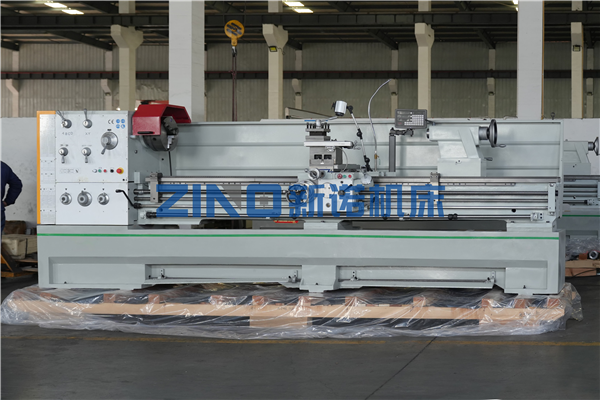
Of course, the heavy conventional lathe has clear limitations. Manual operation leads to relatively weak dimensional repeatability for mass production, and the machining efficiency lags behind automated turning centers for standardized batch parts. The quality of finished products highly depends on the skill, judgment and stability of the machinist. Continuous heavy cutting also brings higher labor intensity. Therefore, it is not intended to replace CNC lathes, but forms a reasonable matching relationship with digital equipment in most mature heavy processing workshops. Factories usually allocate standardized mass production tasks to CNC turning equipment, while reserving this machine for prototype trial production, irregular repair parts, large single casting processing and urgent emergency orders. This collocation balances production efficiency, equipment input and response flexibility, avoiding the waste of high-value automated equipment on scattered, low-batch heavy workpieces.
Looking ahead, although the general trend of manufacturing intelligence will continue to advance, the heavy conventional lathe will not disappear from the industrial scene in the short term. The global heavy equipment industry has continuous demand for overhaul, spare parts customization and on-site repair, and these scenarios always value flexibility and rapid response more than high-speed batch output. Manufacturers are also optimizing its details moderately: improving the lubrication system, optimizing the gear noise reduction structure and adding auxiliary digital readout devices to reduce manual measurement errors, while retaining its core manual driving architecture and heavy-duty rigid body. It is not a backward substitute for intelligent equipment, but a practical, reliable and cost-effective solution for a specific segment of heavy machining.
In conclusion, the value of the heavy conventional lathe lies not in high-speed automation, but in its outstanding rigidity, intuitive operability and strong adaptability to complex, non-repetitive heavy turning jobs. It carries the craftsmanship of traditional metal cutting and fills the gap that automated equipment cannot efficiently cover. As long as heavy industry needs maintenance, custom large rotary parts and technical inheritance of machining skills, this classic machine tool will keep its place in the workshop, serving as a quiet and solid cornerstone of heavy manufacturing.